Cell: a revolutionary Cas13d and the rise of new gene editing tools
Introduction
A team of scientists from the Salk Institute in the United States published a major gene editing article online in the internationally renowned journal Cell. The researchers isolated a new member of the CRISPR-Cas protein family from Ruminococcus flavefaciens and other bacteria, which can efficiently and precisely target and degrade RNA. The researchers named it Cas13d, and its gene interference efficiency can reach 96%, with the potential to replace RNA interference technology.
In today's explosively growing gene editing field, apart from the base editing technology developed by the team of David Liu of Harvard University, a famous Chinese-American scientist and one of Nature's ten people of the year, the star molecule of the CRISPR-Cas family, Cas13a, is definitely on the list. Cas13a has attracted much attention, but unexpectedly, a twin brother, Cas13d, suddenly emerged to compete with it.
On March 15, a team of scientists from the Salk Institute in the United States published a major gene editing article online in the internationally renowned journal Cell. The researchers isolated a new member of the CRISPR-Cas protein family from Ruminococcus flavefaciens and other bacteria, which can efficiently and precisely target and degrade RNA. The researchers named it Cas13d, and its gene interference efficiency can reach 97%, with the potential to replace RNA interference technology [1,2].
Since the discovery of Cas13a, a unique molecule with RNA editing functions, the battlefield of the gene editing field has spread from Cas9-based DNA editing to Cas13a-based RNA editing. Some scientists have even recently exclaimed that the era of RNA editing has arrived [3]! Indeed, Cas13a has a unique RNase domain, HEPN, and can precisely target and degrade RNA under the guidance of a single guide RNA (sgRNA).
How did RNA-targeting gene editing technology become so popular? This is closely related to the competition between two leading figures in the gene editing field, Dr. Zhang Feng of MIT, a famous Chinese-American scientist and pioneer of gene editing, and Professor Jennifer A. Doudna of the University of California, Berkeley, over the application of Cas13a in gene detection.
In fact, as early as 2015, Zhang Feng's laboratory at the famous Broad Institute discovered, by comparing class 2 protein sequences, that Cas13a was different, and speculated that Cas13a has RNase activity [4]. They further reported in Science in April 2016 that Cas13a is an RNA-mediated RNase [5]. However, dramatically, their competitor Professor Doudna published a related article in Nature just a few months later, proving that Cas13a has two RNase activities, and for the first time applied Cas13a to gene detection. However, at that time, the detection sensitivity of Doudna's laboratory could only reach the nM level, which had no practical application value, so it was not further developed [6].
However, Zhang Feng's team combined isothermal amplification technology (RPA) with Cas13a, which greatly improved the sensitivity of detecting gene mutations, and in April 2017 published the Cas13a-based Sherlock technology in the prestigious journal Science, causing a sensation worldwide and giving Cas13a-based gene detection technology practical application value [7].
Just one month ago, the two again engaged in fierce competition: the internationally renowned journal Science simultaneously published two major articles online on February 15 [8,9]. One was from Zhang Feng's laboratory at MIT on the upgraded gene mutation detection technology "Sherlock V2", also mainly based on Cas13a; the other was an extremely sensitive gene mutation detection technology based on modified Cpf1 developed by Professor Doudna's team at the University of California, Berkeley.
Just as the two leaders in the gene editing field were fighting fiercely over the development of RNA-targeting gene editing technology, unexpectedly, a challenger appeared out of nowhere. This challenger is Cas13d.
This is like a plot that often appears in martial arts novels: two masters initially duel for the position of martial arts leader, fighting fiercely, and then a mysterious dark horse suddenly appears and instantly defeats the two previously fiercely competing masters, becoming the supreme martial artist. Cas13d is probably that dark horse.
On March 15, a team of scientists from the Salk Institute in the United States published a major gene editing article online in Cell, isolating a new member of the CRISPR-Cas protein family, belonging to Type VI-D, called Cas13d, which can efficiently and precisely target and degrade RNA, showing more powerful functions than Cas13a in many respects.
How did the researchers isolate this Cas13d? After all, the vast bacterial world is too large, and finding a CRISPR-Cas protein different from previous ones is like searching for a needle in a haystack. It was nothing more than searching for unknown genes through known CRISPR-Cas genes, that is, analyzing sequences near known Cas gene sequences in bacterial genomes through bioinformatics (because bacteria generally need a cluster of genes working collectively to fight phage attacks, genes with similar functions are located close to each other in the genome), and then finding new Cas genes through sequence alignment.
The functions of the newly discovered Cas13d protein may be significantly more powerful than the previous Cas13a. Although Cas13d and the previous Cas13a both have two RNase activity domain HEPN sequences, their other sequences are completely different. Therefore, based on this, the researchers classified Cas13d into the new Type VI-D family of Cas proteins.
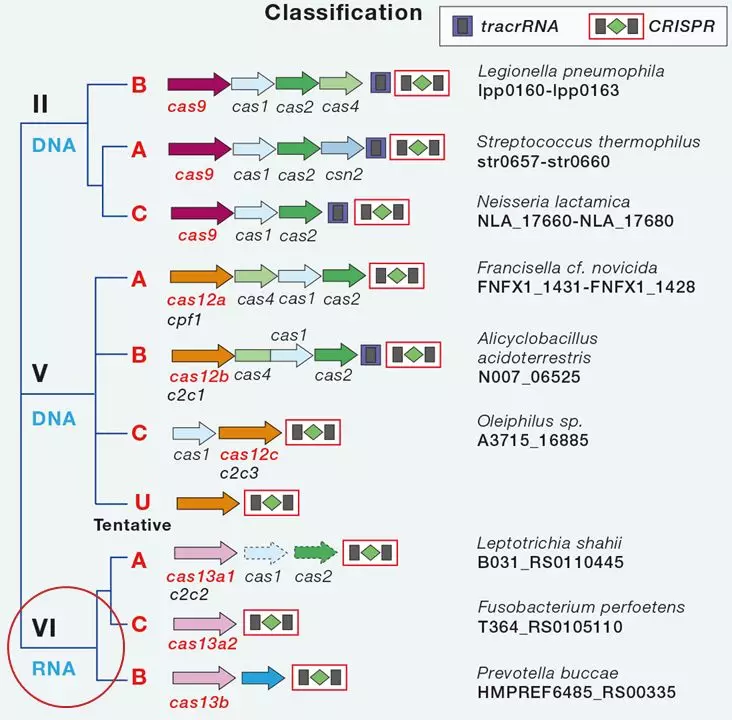
There are many Cas proteins, which are easily confused. Here is a brief introduction to the classification of CRISPR-Cas proteins. In fact, they can be divided into two major classes based on the number of effector proteins at work, namely Class 1 and Class 2. Class 1 requires many proteins working together to exert enzymatic cleavage, while Class 2 Cas proteins require only a single protein, such as Cas9, Cpf1 and Cas13a, all of which can perform cleavage with a single protein. Among them, 90% of Cas proteins belong to Class 1, while Class 2 accounts for only about 10%. Although there are few Class 2 Cas proteins, they are the basis of gene editing technology.
Class 2 Cas proteins can be further divided into Types II, V and VI according to the cleavage substrate (DNA or RNA), among which Cas13a and the newly discovered Cas13d both belong to the Type VI subfamily of Class 2.
So, in what ways is the newly discovered Cas13d more powerful than its "twin brother" Cas13a? What advantages does it have? First, Cas13d has no preference for the PFS sequence (protospacer flanking sequence, equivalent to the PAM sequence of Cas9 for DNA), greatly increasing the application scope of Cas13d. Second, Cas13d has only about 930 amino acids, much smaller than the approximately 1,250 amino acids of other Cas13a proteins, which greatly facilitates loading Cas13d into the adeno-associated virus (AAV) vector, one of the most important vectors for gene therapy today, because the maximum loading capacity of AAV is only about 4.7KB, while other proteins such as Cas13a have already reached the loading limit of AAV. Third, the efficiency of using Cas13d to suppress RNA expression in cells far exceeds conventional shRNA-based RNA interference and Cas13a-based suppression methods.
One major application of RNA-targeting gene editing technology is degrading RNA or suppressing RNA expression in cells, and Cas13d-based RNA silencing technology is far more efficient than conventional shRNA technology and Cas13a-based methods of suppressing RNA expression. Among them, a set of experiments by the researchers showed that the RNA silencing efficiency of Cas13d reached 96%, compared with 65% for the shRNA method and 53% for the Cas13a-based method. More importantly, the Cas13d-based method can efficiently degrade multiple RNAs within cells simultaneously. For example, the researchers used Cas13d to degrade 11 genes in cells at once, with very high efficiency, and almost all suppression efficiencies exceeded 90%.
Of course, the researchers also screened an optimal Cas13d from the XPD3002 subtype of Ruminococcus flavefaciens, named CasRx. In addition, in this study, the researchers also demonstrated the ability to use this new RNA editing system to correct RNA processes. They packaged CasRx into a viral vector and delivered it to neurons cultured from the stem cells of patients with frontotemporal dementia (FTD), ultimately restoring tau protein levels to healthy levels, with an efficiency of 80%.
Dr. Patrick Hsu, corresponding author of the article, finally said: "While conventional gene editing technology can completely turn genes off very well, it is not so good at regulating gene expression. Looking ahead, this latest tool will play an important role in RNA biology research, and is expected to treat RNA-related diseases with this technology in the future."
References: 1. Transcriptome Engineering with RNA-Targeting Type VI-D CRISPR Effectors. 2018. 2. https://www.salk.edu/news-release/crispr-gene-editing-takes-another-big-step-forward-targeting-rna/ 3. RNA-targeting CRISPR comes of age. 2018. 4. Sergey Shmakov et al. Molecular Cell, 2015 5. Omar O. Abudayyeh et al. Science, 05 Aug 2016 6. Alexandra East-Seletsky et al. Nature, 13 October 2016 7. Nucleic acid detection with CRISPR-Cas13a/C2c2. 2017 8. Multiplexed and portable nucleic acid detection platform with Cas13, Cas12a, and Csm6. 9. CRISPR-Cas12a target binding unleashes indiscriminate single-stranded DNase activity. 10. SnapShot: Class 2 CRISPR-Cas Systems. Cell 168, January 12, 2017. Source: Precision Medicine Information Platform, Precision Medicine Network http://www.jzyx.info

About Reforgene
Reforgene Medicine is one of China's leading innovative gene editing drug companies, driven by gene editing technology and dedicated to bringing novel medicines to life. The company has pipeline programs across genetic diseases and complex diseases. Its innovative beta-thalassemia medicine has achieved globally leading clinical progress, and it achieved the world's first cure of an alpha-thalassemia patient.
Media Contact
info@reforgene.com · BD@reforgene.com