
A continuously expanding pipeline
Despite the great achievements in drug development, a large number of patients worldwide still cannot receive effective treatment.
We focus on serious diseases that have no cure or still lack truly effective medicines, including genetic diseases that have long been neglected and major diseases with high incidence.
Unlike traditional drug technologies, we seek solutions at the most fundamental level of life, the genome, breaking through existing boundaries. Innovative gene and cell therapies will bring patients the hope of returning to health.
Gene editing technology is driving a paradigm shift in drug innovation. We are committed to drug development in genetic diseases and complex diseases.
Our pipeline currently includes gene editing medicines across indications including hematology, cardiovascular and metabolic diseases, infectious diseases and ophthalmology.
Thanks to our powerful TIPBAIG™ digital drug development platform, we are achieving continuous product output, with two gene editing medicine modalities today: ex vivo gene editing and in vivo gene editing. We will update the progress of selected pipeline programs on a regular basis.
Gene editing · Hematology
We operate two gene editing medicine modalities: in vivo and ex vivo. Ex vivo gene editing engineers autologous or allogeneic cells before reinfusion into patients. In vivo gene editing delivers editing tools or other therapeutic payloads into the body via LNP or AAV.
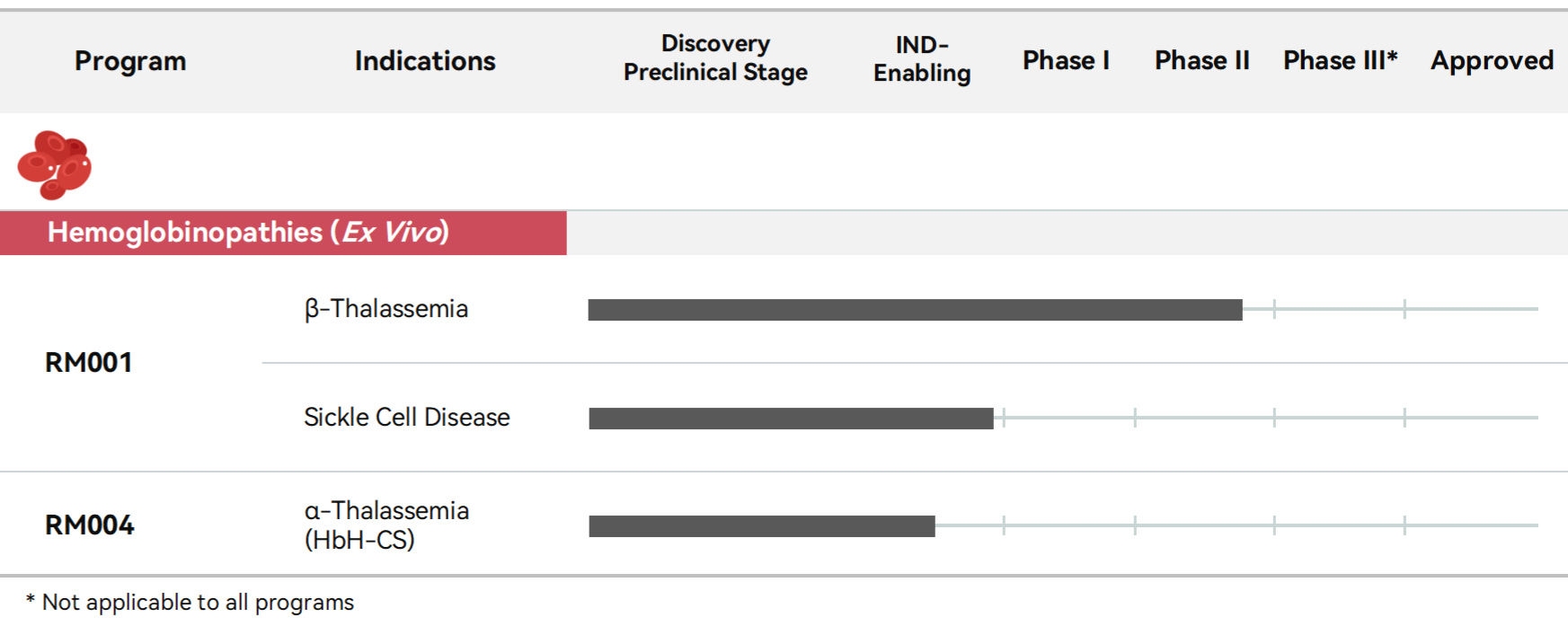
Overview of the hematology gene editing pipeline
RM001 related news and reports
 EHA 2026 (European Hematology Association) Annual Meeting: DURABLE CLINICAL BENEFITS WITH RM001 (AUTOLOGOUS HBG1/2 PROMOTER-MODIFIED CD34+ HEMATOPOIETIC STEM AND PROGENITOR CELLS) FOR TRANSFUSION-DEPENDENT B-THALASSEMIALink ↗
 ASH 2025 (American Society of Hematology) Annual Meeting: All 19 subjects with transfusion-dependent β-thalassemia achieved transfusion independence after treatment with RM001 (autologous HBG1/2 promoter-modified CD34+ hematopoietic stem and progenitor cells)Link ↗
- EHA 2025 Annual Meeting: Updated Safety and Efficacy Results of RM001, Autologous HBG1/2 Promoter-Modified CD34+ Hematopoietic Stem and Progenitor Cells, in Treating Transfusion-Dependent β-ThalassemiaLink ↗
- ASH 2024 Annual Meeting: Updated Safety and Efficacy Results of RM001, Autologous HBG1/2 Promoter-Modified CD34+ Hematopoietic Stem and Progenitor Cells, in Treating Transfusion-Dependent β-ThalassemiaLink ↗
- EHA 2024 Annual Meeting: Safety and Efficacy of RM001, Autologous HBG1/2 Promoter-Modified CD34+ Hematopoietic Stem and Progenitor Cells, in Transfusion-Dependent β-ThalassemiaLink ↗
Reforgene reported Phase I clinical progress of its thalassemia gene editing medicine RM001, helping open the era of gene editing medicines in ChinaLink ↗
- ASH 2023 Annual Meeting: Safety and Efficacy of RM001 (Autologous HBG1/2 Promoter-modified CD34+ Hematopoietic Stem and Progenitor Cells) in Patients with Transfusion-Dependent β-ThalassemiaLink ↗
- EHA 2023 Annual Meeting: Safety and Efficacy of RM001 in Patients with Transfusion-Dependent β-Thalassemia: Early Results from the Ongoing Study of Autologous HBG1/2 Promoter-Modified CD34+ Hematopoietic Stem and Progenitor CellsLink ↗
- ASH 2022 Annual Meeting: Preliminary Result of the Safety and Efficacy of Autologous HBG1/2 Promoter-Modified CD34+ Hematopoietic Stem and Progenitor Cells (RM001) in Transfusion-Dependent β-ThalassemiaLink ↗
Clinical research progress of Reforgene’s thalassemia gene editing medicine RM001 was presented at the 64th ASH Annual Meeting in 2022Link ↗
Reforgene’s beta-thalassemia gene editing medicine received IND approval from the NMPALink ↗
- EHA 2022 Annual Meeting: Initial Safety and Efficacy Study of RM001, Autologous HBG1/2 Promoter-Modified CD34+ Hematopoietic Stem and Progenitor Cells, in Transfusion-Dependent β-ThalassemiaLink ↗
Reforgene presented the world’s first novel-target gene editing thalassemia clinical results at the 2022 EHA CongressLink ↗
First breakthrough: China’s gene editing technology successfully treats adult patients with severe thalassemiaLink ↗
The world’s first novel-target treatment for severe beta-thalassemia: Reforgene achieves a new breakthroughLink ↗
Gene editing · In vivo & ex vivo gene editing
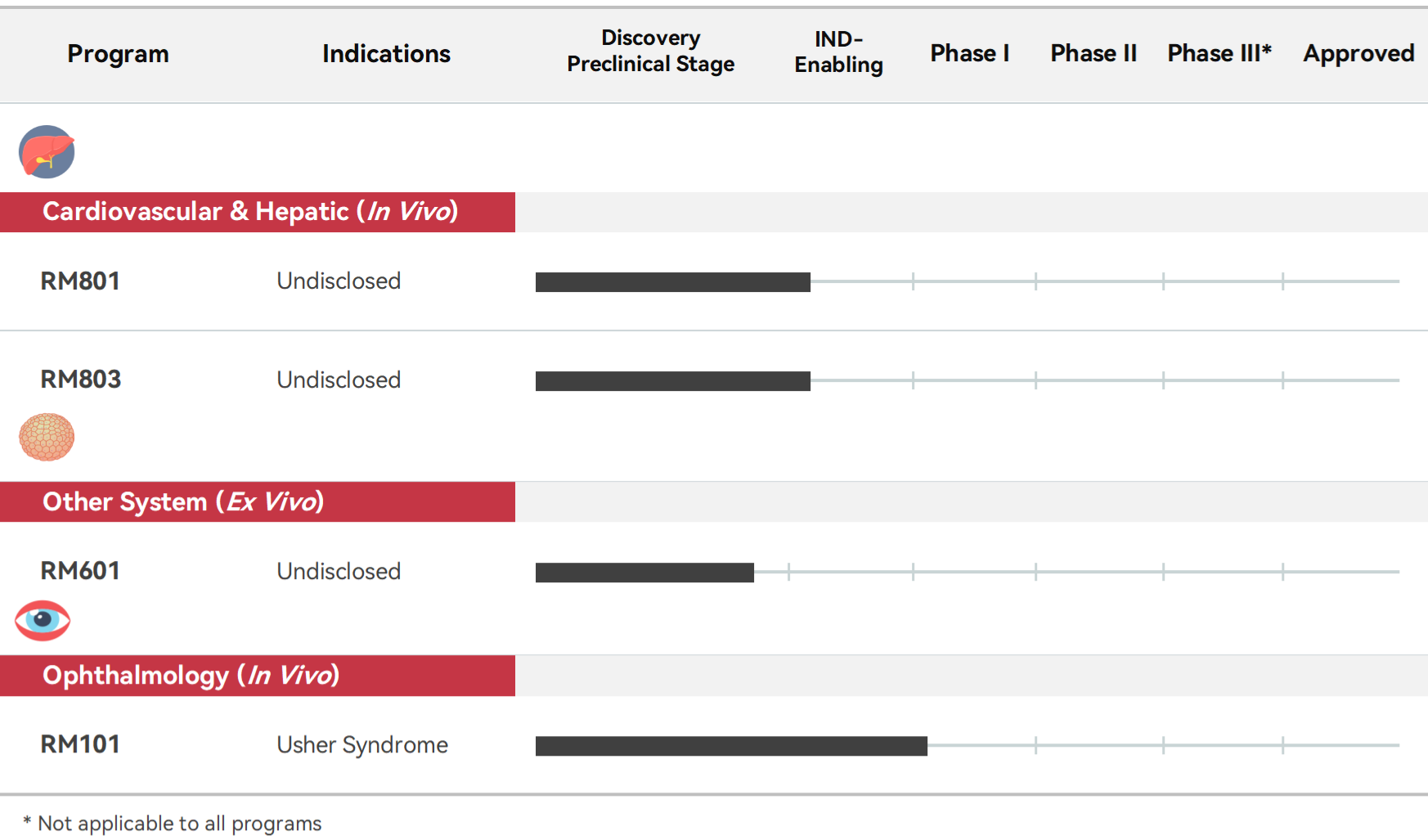
Overview of the cardiovascular & hepatic, other system and ophthalmology gene editing pipeline