Reforgene achieves a new breakthrough in treating severe beta-thalassemia with a novel global target
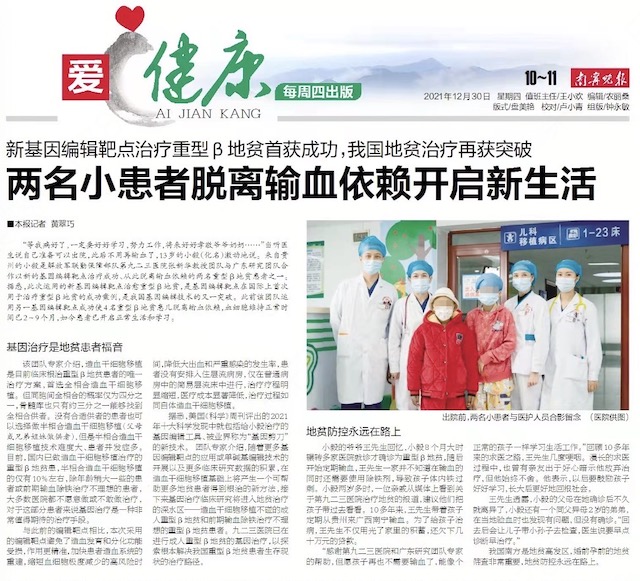
Editor's note: The clinical research results in which Guangzhou Reforgene Medicine participated as the drug R&D institution were recently reported by Nanning Evening News.
A new gene editing target achieves first success in treating severe beta-thalassemia: another breakthrough in thalassemia treatment in China
Two young patients escape transfusion dependence and start a new life. (Nanning Evening News, reporter Huang Cuiqiao)
"When I recover, I will study hard, work hard, and take good care of my grandparents in the future..." When the doctor said he could soon be discharged and would no longer need blood transfusions, 13-year-old Xiao Yi (pseudonym) said excitedly. Xiao Yi, from Guizhou, is one of two patients with severe beta-thalassemia who were successfully treated with a new gene editing target and have since escaped transfusion dependence, through the collaboration between the team of Professor Zhang Xinhua of the 923rd Hospital of the PLA Joint Logistic Support Force and a Guangdong research team. It is reported that the cure of severe beta-thalassemia with this new gene editing target is the first successful international case of using a new gene editing target to treat severe beta-thalassemia, and another breakthrough in China's gene editing technology. Previously, the team used another gene editing target to successfully free 4 children with severe beta-thalassemia from transfusion dependence, with blood cells maintained normal for 2-9 months; the patients have now returned to normal life and study.
Gene therapy is good news for thalassemia patients
The team's experts introduced that hematopoietic stem cell transplantation is currently the only clinical treatment that can cure patients with severe beta-thalassemia, with fully matched hematopoietic stem cell transplantation as the first choice. However, the probability of full matching between siblings is only one quarter, and only about one third of patients can find a fully matched donor in the bone marrow bank. Patients without a suitable donor can also choose haploidentical hematopoietic stem cell transplantation (with parents or siblings as donors), but haploidentical transplantation is technically difficult and has many complications. At present, among patients with severe beta-thalassemia who have undergone hematopoietic stem cell transplantation in China, haploidentical transplantation accounts for only about 10%. Except for somewhat older patients or those with unsatisfactory prior transfusion and iron chelation treatment, most hospitals are unwilling or afraid to perform the treatment. For these patients, gene therapy is a very worthwhile treatment to look forward to.
Compared with the previous editing target, the editing target used this time avoids impairment of hematopoietic development and differentiation functions, acts more precisely, accelerates the reconstruction of the patient's hematopoietic system, shortens the high-risk period of extreme blood cell reduction, and reduces the incidence of major bleeding and severe infection. The patients were not admitted to a laminar flow ward, but treated only in a simple laminar flow bed in a general ward, significantly shortening the treatment course and reducing medical costs. The treatment process is like autologous hematopoietic stem cell transplantation.
It is reported that the 2021 top ten scientific discoveries selected by the U.S. journal Science include the gene editing tool used to treat Xiao Yi, the new technology known in the industry as "gene scissors". The team's experts introduced that with the application of more gene editing targets, the development of base editing technology and the accumulation of more clinical research data, a new method will emerge on the basis of hematopoietic stem cell transplantation that can help more thalassemia patients achieve radical cure. Next, gene therapy clinical research will enter the deep-water zone of thalassemia treatment: adult patients with severe beta-thalassemia, whom hematopoietic stem cell transplantation does not touch, and patients with severe beta-thalassemia with unsatisfactory prior transfusion and iron chelation treatment. The 923rd Hospital is already conducting gene therapy for adult severe beta-thalassemia to explore a treatment path that fundamentally solves the survival situation of patients with severe beta-thalassemia in China.
Thalassemia prevention and control is always on the road
Xiao Yi's grandfather, Mr. Wang, recalled that Xiao Yi was diagnosed with severe beta-thalassemia at 8 months old only after visiting many hospitals, and then began regular blood transfusions. The Wang family did not know that iron chelators were also needed alongside transfusions, resulting in iron overload in the child. When Xiao Yi was just over two years old, a relative saw a media report about the 923rd Hospital's treatment of thalassemia and suggested they take the child there. For more than 10 years, Mr. Wang took the child regularly from Guizhou to Nanning, Guangxi, for blood transfusions. To treat the child, Mr. Wang not only used up the family's savings but also took on hundreds of thousands of RMB in loans.
"Thanks to the experts of the 923rd Hospital and the Guangdong research team for their help. I hope the child will never need blood transfusions again and can study, live and work like a normal child." Looking back on the road of seeking treatment over more than 10 years, Mr. Wang choked up several times. During the long treatment process, some relatives and friends, out of kindness, hinted that he should give up the treatment, but he never relented. He said he would encourage the child to study hard and better repay society when she grows up.
Mr. Wang revealed that Xiao Yi's parents divorced shortly after her diagnosis, and Xiao Yi has a 2-year-old half-brother whose blood test also found problems locally, but without a confirmed diagnosis. "After returning, I will have my son take the little grandson for a check-up. The doctor said early diagnosis and early treatment are important."
Southern China is a high-incidence area for thalassemia, and premarital and pre-pregnancy thalassemia screening is very important. Thalassemia prevention and control is always on the road. Source: Nanning Evening News.

About Reforgene
Reforgene Medicine is one of China's leading innovative gene editing drug companies, driven by gene editing technology and dedicated to bringing novel medicines to life. The company has pipeline programs across genetic diseases and complex diseases. Its innovative beta-thalassemia medicine has achieved globally leading clinical progress, and it achieved the world's first cure of an alpha-thalassemia patient.
Media Contact
info@reforgene.com · BD@reforgene.com