Two gene therapies can cure rare genetic diseases
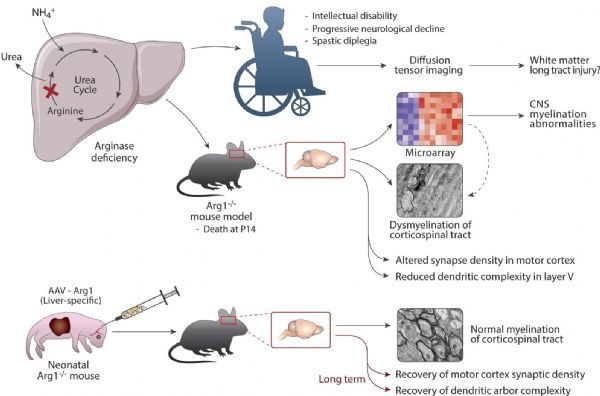
Arginase deficiency is a rare inherited disease that causes the accumulation of the amino acid arginine in the blood. When affected infants begin to toddle, their muscles become stiff, followed by seizures, tremors and developmental delay; over time, the disease can lead to severe intellectual disability.
Scientists at the University of California, Los Angeles have developed two new approaches to deliver a functional copy of the arginase gene to mice lacking arginase. One approach treats mice every three days, using tiny nanoparticles to carry arginase RNA into the liver. The other uses a virus to deliver arginase DNA to the liver; if correctly administered in mice 2-4 days old, a single dose can prevent the symptoms of arginase deficiency in the animals.
Dr. Gerald Lipshutz, professor of surgery at UCLA and senior author of both studies, said: "We are in an era of innovation in genomics and genetics, and we can bring new targeted therapies to patients with genetic diseases. These therapies may initially benefit only a small number of people with rare diseases, but will eventually be applied more broadly."
Arginase deficiency is caused by deletion or mutation of the arginase gene ARG1, and affects about one in every million births in the United States. Arginase is one of six proteins in the liver involved in breaking down and clearing arginine from the body. Without the action of arginase, arginine accumulates in the blood and causes problems, mainly in the brain.
Many people with the disease try to manage it with a strict protein-restricted diet, which helps them avoid nitrogen and arginine intake from the start. There are also drugs that can remove excess nitrogen from the blood, but they are expensive and not very effective for most people.
To help develop new treatments, Lipshutz and his collaborators first sought to better understand how arginase deficiency affects the brain in a way that leads to disease development and neurological symptoms. In a paper published in JCI Insight, the scientists reported that the brains of arginase-deficient mice contained less than a quarter of the normal level of myelin. Myelin is a substance that wraps around brain cells like an insulator and is key to communication between brain regions.
To test whether loss of ARG1 causes myelin loss, Lipshutz's team designed a virus that can carry a new copy of ARG1 DNA. When the team injected the virus intravenously into 2-day-old ARG1-deficient mice, their myelin was no longer defective. The virus-treated mice had near-normal levels of bone marrow cells.
"With just one dose, we can prevent these brain abnormalities," Lipshutz said. "Going from almost no myelination to near normal is very dramatic."
Researchers studying other genetic diseases have investigated using viruses to deliver healthy DNA to patients. Data from these studies suggest that such therapy may lose effectiveness after many years. Because relatively few patients with genetic diseases have received such treatment, researchers must still determine whether the same phenomenon occurs in humans. However, Lipshutz said that a virus-based therapy replacing ARG1 does have the potential to work in humans.
Lipshutz and his colleagues are currently studying cells taken from patients with arginase deficiency to determine whether they also have myelination defects, and plan to explore the molecular link between high arginine levels in the brain and myelin loss, in order to find other targeted drugs to treat arginase deficiency.
In a second paper published in PNAS, Lipshutz collaborated with Moderna of Cambridge, Massachusetts to develop a nanoparticle that can deliver RNA encoding the arginase protein to the liver. Mice without any functional ARG1 quickly developed symptoms of arginase deficiency and all died within 22 days; however, mice treated with the nanoparticles were still alive after 11 weeks without any disease symptoms. However, the drug must be taken every three days to continuously replenish arginase levels in the liver.
"As long as we continue to give the treatment, these animals have completely normal metabolites in their blood," Lipshutz said.
He said the new study confirms that liver-based therapy can effectively treat systemic arginase deficiency. Further research is needed to determine whether nanoparticle-based arginase therapy is safe and effective. Source: 生物谷 Bioon.com.

About Reforgene
Reforgene Medicine is one of China's leading innovative gene editing drug companies, driven by gene editing technology and dedicated to bringing novel medicines to life. The company has pipeline programs across genetic diseases and complex diseases. Its innovative beta-thalassemia medicine has achieved globally leading clinical progress, and it achieved the world's first cure of an alpha-thalassemia patient.
Media Contact
info@reforgene.com · BD@reforgene.com