Nature reports precise PTB gene regulation that eliminates Parkinson's symptoms
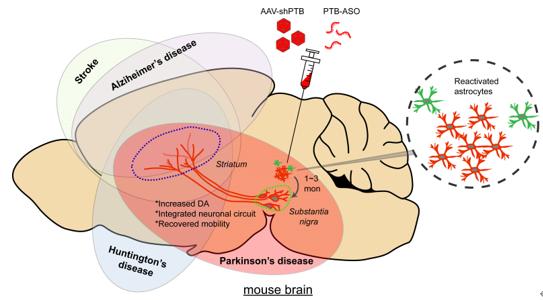
On June 24, 2020, the team of Fu Xiangdong at the University of California San Diego published a research paper in Nature titled "Reversing a model of Parkinson's disease with in situ converted nigral neurons". The study found that knocking down the RNA-binding protein PTB in astrocytes can directly transdifferentiate them into functional neurons. This one-step transdifferentiation technique can induce the generation of new functional dopaminergic neurons in a Parkinson's disease mouse model, rebuild damaged neural circuits, restore striatal dopamine levels, and effectively treat Parkinson's syndrome-related motor disorders. More importantly, antisense oligonucleotides (ASO) that inhibit PTB can also achieve similar therapeutic effects. This study provides highly promising therapeutic strategies and methods for Parkinson's disease and other neurodegenerative diseases, and has received widespread attention in the neuroscience field. The study was selected as a Nature cover article.
Finally, Ernest Arenas of the Karolinska Institute in Stockholm, Sweden, published a commentary online in Nature titled "Method to combat Parkinson's disease by astrocyte-to-neuron conversion", which systematically reviewed the research results and pointed out that the study is expected to open a new chapter for the development of regenerative medicine for neurological diseases such as Parkinson's disease.
Neurodegenerative diseases are one of the major threats to population health in an aging society. Taking Parkinson's disease as an example, there are already more than ten million patients worldwide, and the current drug and surgical treatments can only delay disease progression but cannot completely cure it. To fundamentally restore patients' physiological functions, it is necessary to transplant neurons in vitro or regenerate new neurons in situ. However, transplantation treatment using neurons differentiated from induced pluripotent stem cells (iPSC) has problems such as difficult integration, tumorigenicity and immunogenicity. Therefore, direct in situ transdifferentiation of neurons from glial cells may be an effective strategy to cure neurodegenerative diseases. Unlike the "addition" strategy of overexpressing neuron-specific transcription factors in glial cells to induce in situ neural regeneration [1-2], Professor Fu Xiangdong proposed a "subtraction" strategy, that is, inducing neuronal generation by knocking down in non-neuronal cells a key inhibitory factor that is naturally downregulated during neural differentiation, the RNA-binding protein PTB. This method is simpler, safer and easier to operate.
Professor Fu Xiangdong is a leading figure in the field of RNA functional genomics, and a chance discovery ten years ago led him to the development of treatments for neurodegenerative diseases. In 2009, Professor Fu's doctoral student Xue Yuanchao (now a researcher at the Institute of Biophysics of the Chinese Academy of Sciences), while studying the positional effects and molecular mechanisms of PTB in regulating RNA splicing within cells [3], inadvertently discovered that HeLa cells with stable PTB knockdown grew neurite-like processes. In-depth research found that mouse fibroblasts after PTB knockdown could be converted into functional mature neurons; this work was published in Cell in 2013 [4]. Subsequently, researcher Xue Yuanchao, in close collaboration with Dr. Qian Hao, a postdoctoral fellow in Fu's laboratory, published a research paper in Nature Neuroscience in 2016 on the transdifferentiation of human fibroblasts into neurons [5], elucidating the two regulatory loops, mainly PTB and nPTB, required during neuronal transdifferentiation of human cells.
On this basis, Dr. Qian Hao and others, with the strong assistance of Professor Zhou Zhuan of Peking University and Professor Kang Xinjiang of Southwest Medical University, finally achieved the knockdown of PTB in mouse astrocytes and their in situ transdifferentiation into functional neurons, and confirmed that the "subtraction" strategy has significant therapeutic effects in Parkinson's disease model mice. This exciting work was first submitted to Science in December 2017, then supplemented with a large amount of experimental data based on suggestions from multiple parties, submitted to Nature in November 2018, and officially accepted in May this year. From September 2017 to the present, Professor Fu Xiangdong has maintained an open scientific attitude, sharing the experimental design and research results of this study at multiple research institutions and academic conferences at home and abroad. In particular, in June 2018, Professor Fu was invited to the Shanghai Institute of Neuroscience of the Chinese Academy of Sciences to present this research work, which attracted high attention in the domestic neuroscience field and received widespread acclaim.
In this paper, the authors first discovered that isolated mouse or human astrocytes, after PTB knockdown, can be efficiently transdifferentiated into mature neurons expressing the marker proteins TUJ1 and MAP2, and that these neurons are functional, possessing neuron-specific sodium currents and action potentials, with detectable postsynaptic currents.
After obtaining in vitro experimental evidence, the authors constructed an adeno-associated virus vector, using the astrocyte-specific GFAP promoter to drive PTB shRNA expression, and co-expressed a red fluorescent protein for tracing. After injecting the adeno-associated virus into the midbrain, they found that PTB knockdown was achieved in astrocytes, which in turn induced neuronal transdifferentiation. Due to the influence of the brain region microenvironment, many of the neurons generated by transdifferentiation in the midbrain were dopaminergic neurons expressing TH. Based on this, the authors selected a Parkinson's disease mouse model with 6-OHDA-induced damage to verify that this strategy regenerates dopaminergic neurons in situ, and found that the newly generated neurons can secrete dopamine normally and restore the mice's impaired motor behavior to normal.
To confirm whether the new neurons converted in situ from astrocytes rebuilt the damaged neural pathways, the authors used retrobeads retrograde tracing to verify the projection of new neurons from the substantia nigra of the midbrain to the striatum, and further introduced chemogenetics (DREADD) to manipulate the transdifferentiated neurons, observing that the corresponding motor behavior of the mice depended on whether the new neurons functioned normally. This series of experimental results strongly demonstrates that the transdifferentiation-induced neurons rebuilt the damaged nigrostriatal pathway and reversed the functional impairment caused by neural damage.
In addition to using adeno-associated virus, the authors also tried injecting antisense oligonucleotides that inhibit PTB into Parkinson's disease mice, and found that they could likewise promote transdifferentiation from astrocytes to neurons and effectively reverse the mice's motor deficit symptoms. These findings not only confirm the effectiveness of antisense oligonucleotides in inducing neuronal transdifferentiation, but also lay a solid foundation for developing drugs related to Parkinson's disease.
In summary, Professor Fu Xiangdong's team used adeno-associated virus shRNA or antisense oligonucleotide drugs to reduce PTB levels, successfully transdifferentiated astrocytes into dopaminergic neurons in the midbrain of Parkinson's disease model mice, and effectively reversed the mice's motor disorder symptoms. Coincidentally, in April this year, the group of Yang Hui at the Shanghai Institute of Neuroscience of the Chinese Academy of Sciences also published a related paper in Cell: they used the CRISPR-CasRx system to mediate Ptbp1 knockdown, converting glial cells into retinal ganglion cells and dopaminergic neurons in the mouse retina and brain striatum, respectively, further supporting the feasibility of the "subtraction" strategy in treating neurodegenerative diseases [6].
This breakthrough research in Professor Fu Xiangdong's laboratory took ten years. Starting from a biological phenomenon, it first analyzed in detail the regulatory mechanism of neuronal differentiation centered on PTB [7], and then gradually advanced from theoretical exploration to clinical translation related to disease treatment, demonstrating the infinite charm and importance of basic research. Professor Fu Xiangdong said: "The current goal is to move this technology into clinical trials as soon as possible to test its therapeutic effect on patients with Parkinson's syndrome. At the same time, we also plan to conduct similar research on other neurodegenerative diseases caused by neuronal loss, including Alzheimer's disease, Huntington's disease and stroke. I intend to devote the rest of my life to these R&D efforts."
References: 1. Pang, Z. P. et al. Induction of human neuronal cells by defined transcription factors. Nature 476, 220-223 (2011). 2. Guo, Z. et al. In vivo direct reprogramming of reactive glial cells into functional neurons after brain injury and in an Alzheimer's disease model. Cell Stem Cell 14, 188-202 (2014). 3. Xue, Y. et al. Genome-wide analysis of PTB-RNA interactions reveals a strategy used by the general splicing repressor to modulate exon inclusion or skipping. Mol Cell, 36, 996-1006 (2009). 4. Xue, Y. et al. Direct conversion of fibroblasts to neurons by reprogramming PTB-regulated microRNA circuits. Cell 152, 82-96 (2013). 5. Xue, Y. et al. Sequential regulatory loops as key gatekeepers for neuronal reprogramming in human cells. Nat Neurosci 19, 807-815 (2016). 6. Zhou, H. et al. Glia-to-neuron conversion by CRISPR-CasRx alleviates symptoms of neurological disease in mice. Cell 181, 590-603 (2020). 7. Hu, J. et al. PTB/nPTB: master regulators of neuronal fate in mammals. Biophys Rep 4, 204-214 (2018).
Expert commentary
Chen Shengdi (Professor, Chief Physician and doctoral supervisor at Ruijin Hospital affiliated to Shanghai Jiao Tong University School of Medicine; Director of the Department of Neurology and the Teaching and Research Office of Neurology; Vice Chairman of the Neurology Branch of the Chinese Medical Association; Chairman of the Basic and Clinical Neurology Committee of the Chinese Neuroscience Society; a renowned Parkinson's syndrome expert)
Parkinson's disease is a common neurodegenerative disease of middle-aged and elderly people, with a prevalence of 1.7% in people over 65 in China, rising with age. As China gradually enters an aging society, Parkinson's disease has become a heavy burden on families and society. The cause of Parkinson's disease is the progressive degeneration of dopaminergic neurons in the substantia nigra, which in turn leads to reduced dopamine transmitters in the striatum and an imbalance between dopamine and acetylcholine transmitters. Patients mostly exhibit motor symptoms such as tremor, muscle rigidity, bradykinesia and postural balance disorders, as well as varying degrees of non-motor symptoms such as reduced sense of smell, sleep disorders, constipation and depression. At present, clinical treatment is mainly drug therapy, supplemented by surgical treatment. It should be pointed out that neither drug nor surgical treatment can improve patients' symptoms only, without completely halting disease progression, let alone curing it. A complete cure of Parkinson's disease requires the development of new therapies (such as in situ regeneration of dopaminergic neurons).
It is gratifying to see the research work of Professor Fu Xiangdong's team from the University of California San Diego published in Nature today. They adopted a highly innovative in situ transdifferentiation strategy: by knocking down the RNA-binding protein PTB, they directly transdifferentiated glial cells in the substantia nigra region of the midbrain into functional dopaminergic neurons, significantly improving the motor symptoms of Parkinson's disease mouse models. Excitingly, Professor Fu's team further proved that antisense oligonucleotides (ASO) can also generate dopaminergic neurons in situ in the midbrain and effectively improve the 6-hydroxydopamine-induced Parkinson's disease pathological phenotype, laying a solid foundation for subsequent clinical application research and bringing dawn to the cure of Parkinson's disease! In this research, Professor Fu's team comprehensively used the most rigorous lineage tracing, chemogenetics, high-performance liquid chromatography and carbon fiber electrodes to rigorously prove the regeneration and functionality of dopaminergic neurons. We hope this research result will be quickly translated into clinical application for the benefit of Parkinson's disease patients!
Pang Zhiping (Associate Professor, Department of Neuroscience and Cell Biology, Robert Wood Johnson Medical School, Rutgers University, USA)
It is well known that neurodegenerative diseases (including Parkinson's disease and Alzheimer's disease) and neural injuries (including stroke and spinal cord injury) not only seriously affect patients' quality of life, but also impose a heavy economic burden on families and society. A fundamental problem in treating the above diseases is how to achieve neuronal regeneration. The cover article recently published in Nature by Professor Fu Xiangdong of the University of California reports that in situ conversion of midbrain dopaminergic neurons can restore motor function in Parkinson's disease animal models, which is an exciting research result in the field of neuronal regeneration!
In recent years, with the development of regenerative medicine and developmental biology, people have applied innovative approaches to make exciting discoveries in neuronal regeneration. For example, the discovery of induced pluripotent stem cells made it possible to convert cells of different origins using four transcription factors, for which discoverer Shinya Yamanaka won the 2012 Nobel Prize in Physiology or Medicine. Technically similar, the transdifferentiation of other cells into neurons using transcription factors or microRNAs was also discovered in 2010-2011 by Marius Wernig, Thomas Südhof and Gerald Crabtree of Stanford University [1-3].
Among them, Professor Fu Xiangdong of the University of California San Diego is a recognized expert in RNA and RNA-binding proteins. Through the efforts of researcher Xue Yuanchao (now a researcher at the Institute of Biophysics of the Chinese Academy of Sciences) and others, it was discovered in 2013 that the gene network regulated by the RNA-binding protein PTB is an important mechanism limiting cell transdifferentiation into neurons, and papers were successively published in Cell (2013) and Nature Neuroscience (2016) reporting the conversion of fibroblasts into neurons in vitro [4, 5]. These early pioneering studies laid a solid foundation for the findings of this article. Previously, Professor Chen Gong of Jinan University, Professor Chen Leping of the Chinese Academy of Sciences, and Professor Zhang Chunli of the University of Texas Southwestern Medical Center also made breakthrough progress in in situ neuronal regeneration [6-8].
In this article, Professor Fu followed their earlier discovery of the PTB gene network and reported that knocking down the PTB protein can convert glial cells in the brains of mice and humans into functional neurons, especially converting glial cells in the substantia nigra region of the midbrain into dopaminergic neurons in vivo. Because the death of dopaminergic neurons is the culprit of Parkinson's disease, this result is particularly exciting. Professor Fu's group also found that knocking down PTB in different brain regions produces different types of neurons, which is also very meaningful for regenerative medicine. Next, they found that the axons of the in situ-converted midbrain dopaminergic neurons can not only grow to the forebrain striatum, but also restore the motor behavior function of Parkinson's disease mice. Some previous strategies (such as the research of Lorenz Studer and others) mostly transplanted early embryonic dopaminergic neurons and stem cell-differentiated dopaminergic neurons into the striatum [9, 10], but whether a normal neural network could be formed and whether it could receive regulation from neural inputs was unknown.
It is well known that neurons in different brain regions receive different network regulation information, so the in situ regeneration strategy adopted by Professor Fu's team can obtain region-specific neurons subject to normal regulation. Next, Professor Fu and his team collaborated with Professor Zhou Zhuan of Peking University to directly measure dopamine release in the striatum using carbon fibers (Professor Zhou is a pioneer in inventing carbon fiber measurement of dopamine), providing convincing evidence that in situ-converted midbrain dopaminergic neurons release dopamine at axon terminals. Finally, they used chemogenetics to study the pharmacological controllability of these cells, and screened antisense oligonucleotides for efficient neuronal transdifferentiation. These advances all provide a solid foundation for clinical translation.

About Reforgene
Reforgene Medicine is one of China's leading innovative gene editing drug companies, driven by gene editing technology and dedicated to bringing novel medicines to life. The company has pipeline programs across genetic diseases and complex diseases. Its innovative beta-thalassemia medicine has achieved globally leading clinical progress, and it achieved the world's first cure of an alpha-thalassemia patient.
Media Contact
info@reforgene.com · BD@reforgene.com