Two gene editing scientists win the 2020 Nobel Prize in Chemistry
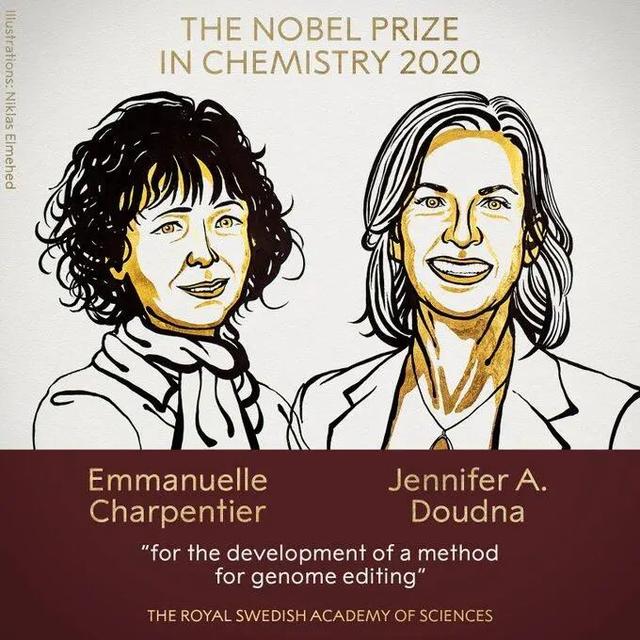
The 2020 Nobel Prize in Chemistry was awarded on the 7th to two female scientists, in recognition of their contributions to method research. The genome editing method here refers to the currently popular CRISPR/Cas9 gene editing technology. On October 7, in Stockholm, Sweden, the electronic screen at the Nobel Prize announcement site of the Royal Swedish Academy of Sciences displayed the two award-winning female scientists.
Deoxyribonucleic acid (DNA) is an important genetic material with a double-stranded structure of intertwined helices. DNA fragments that contain genetic information and have certain functions on the DNA chain are genes. Gene editing technology can break the DNA chain, modify it, and then reconnect it, just like people editing text when writing. Because of the cutting operation on the DNA chain, this technology is vividly called "gene scissors".
Gene editing technology appeared as early as the 1990s and was once very time-consuming and even difficult to accomplish. Using CRISPR/Cas9 gene editing technology, the code of life, DNA, can be changed within a few weeks. The full name of CRISPR is "clustered regularly interspaced short palindromic repeats", a mechanism by which bacteria defend against viral invasion. In 2012, French scientist Emmanuelle Charpentier and American scientist Jennifer A. Doudna published research stating that they had developed the CRISPR/Cas9 gene editing technology. This technology subsequently became the first tool in the history of biomedicine capable of efficiently, precisely and programmatically modifying the human genome and other cellular genomes. This technology uses ribonucleic acid (RNA) as a guide, brings the Cas9 enzyme to the corresponding position, and then uses this enzyme to cut viral DNA.
Compared with previous technologies, CRISPR/Cas9 technology has the advantages of low cost, ease of use and high efficiency, making the trimming and modification of genes "commonplace", and therefore swept through the entire biological community. The scientific community generally believes that this is the most important breakthrough in biotechnology since the 21st century. This technology was shortlisted three times for Science magazine's annual top ten breakthroughs, and was named the top breakthrough of the year by the magazine in 2015.
On October 7, at the Royal Swedish Academy of Sciences in Stockholm, people listened to experts' interpretation of the achievements of this year's Nobel Prize in Chemistry laureates.
As often happens in science, the discovery of "gene scissors" was also unexpected. While studying Streptococcus pyogenes, Charpentier discovered an unknown molecule, tracrRNA. Her research showed that tracrRNA is part of bacteria's ancient immune system "CRISPR/Cas", capable of "disarming" viruses by cutting their DNA and thereby eliminating their harm.
Charpentier published the above research results in 2011. In the same year, she began collaborative research with Doudna. In an epoch-making experiment, they modified the "gene scissors". In its natural form, these "scissors" can recognize DNA in viruses. But Charpentier and Doudna found that the "scissors" could be controlled, so that any DNA molecule could be cut at any predetermined position. Once the DNA is cut, rewriting the code of life becomes simple.
Since then, the use of the "gene scissors" technology has grown explosively. In basic research, many major achievements have emerged with its application. For example, plant researchers have developed crops resistant to mold, pests and drought; in medicine, clinical trials of new cancer therapies related to this technology are underway, and curing genetic diseases is expected to become a reality.
Overall, the "gene scissors" technology has opened a new era in life science research and benefited humanity in many ways. The Nobel Committee for Chemistry said in a press release on the 7th: "This gene editing tool has enormous power and will affect each of us. It has not only triggered changes in basic science, but has also produced many innovative results and will bring original new treatment methods." (End) (Xinhua special report) Source: Xinhua News Agency.

About Reforgene
Reforgene Medicine is one of China's leading innovative gene editing drug companies, driven by gene editing technology and dedicated to bringing novel medicines to life. The company has pipeline programs across genetic diseases and complex diseases. Its innovative beta-thalassemia medicine has achieved globally leading clinical progress, and it achieved the world's first cure of an alpha-thalassemia patient.
Media Contact
info@reforgene.com · BD@reforgene.com