Repairing genes with an approved 'gene scissors': a girl with severe thalassemia achieves clinical cure
On August 1, 2023, Southern Metropolis Daily published a report on the clinical trial of RM001, the beta-thalassemia gene editing medicine developed by Reforgene, at Sun Yat-sen Memorial Hospital of Sun Yat-sen University.
More than 10 years ago, when basic medical scientists developed and continuously improved gene editing technology, and used the increasingly refined CRISPR/Cas technology to "carve" at the subtle gene level, it became possible for modern medicine to use this "scissors" of gene editing to modify specific disease-causing genes to treat diseases.
Chinese basic and clinical medical scientists are also reasonably and compliantly using gene editing technology to treat specific gene defect diseases. Using a "scalpel" at the microscopic gene level to partially or completely "cut out" specific gene fragments, or to repair and fill gaps in disease-causing genes at a more advanced level, has one purpose: to change the disease-causing expression of the gene and cure the patient.
Recently, the pediatric hematology-oncology team of Sun Yat-sen Memorial Hospital of Sun Yat-sen University used RM001, China's first novel-target thalassemia gene editing innovative medicine project with implied clearance from the NMPA, to successfully clinically cure Xiaolin, a 16-year-old patient with severe beta-thalassemia, without using donated allogeneic stem cell transplantation. The girl who needed monthly blood transfusions and daily iron chelation has been reborn. "This scheme does not require matching; it completely uses the patient's own 100% matched stem cells for 'micro-carving modification' before reinfusion into the body for treatment. Autologous hematopoietic stem cell transplantation based on gene therapy is becoming a new hope for curing beta-thalassemia."
Suffering from severe beta-thalassemia: a teenage girl faces "endless treatment"
16-year-old Xiaolin is an outgoing girl skilled in music, chess, calligraphy and painting, no different from ordinary people in study and sports. However, suffering from severe beta-thalassemia, she needed 8 units of blood transfusion per month and iron chelation drugs every day. To give her the fullest care, her parents did not have another child, doing their utmost to maintain Xiaolin's healthy growth. After 16 long years of treatment, Xiaolin and her family had exhausted their energy on the extremely scarce blood supply and the endless iron chelation treatment.
Allogeneic hematopoietic stem cell transplantation is also a curative option, but in the vast sea of people, finding a stem cell donor with 100% matching for Xiaolin has a theoretical probability of between 1 in 300,000 and 1 in 100,000. Without a matching hematopoietic stem cell donation, transplantation surgery would remain a mirage.
Gene therapy, advancing through exploration based on continuously improving gene editing technology, became Xiaolin's only hope for cure.
Professor Fang Jianpei introduced that severe beta-thalassemia is a hereditary blood disease, with Guangdong, Guangxi, Hainan, Hunan, Sichuan, Guizhou, Yunnan and other areas of China as high-incidence regions. Affected children gradually develop anemia after birth, which progressively worsens, requiring lifelong blood transfusions to sustain life. Due to repeated transfusions 1-2 times per month, iron deposits in various organs of the child's body, commonly known as "iron overload", which is in fact a form of "chronic iron poisoning", leading to various complications affecting appearance, bones, endocrine and more. Patients need to persist in lifelong regular transfusions and drug iron chelation to sustain life, but the costs are high, compliance is difficult, and the impact on quality of life is enormous.
Previously, allogeneic hematopoietic stem cell transplantation was the only radical cure. However, most patients do not have suitably matched donors, and haploidentical transplantation carries high risks; after successful engraftment, complications such as chronic graft-versus-host disease seriously reduce quality of life, and many patients cannot achieve radical cure. Since the clinical translation of gene therapy technology began, many thalassemia families have been eagerly awaiting it. In recent years, the Sun Yat-sen University team has worked tirelessly to apply gene editing technology to the clinical translation of thalassemia and other diseases.
New technology brings a "turnaround": the young patient successfully exits the cabin after reinfusion of gene-repaired stem cells
In November 2022, the NMPA approved the Phase I clinical study of the RM001 cell injection. Xiaolin, meeting all enrollment conditions, saw new hope.
After strict review by the Ethics Committee of Sun Yat-sen Memorial Hospital and full communication with the family, in February 2023 Xiaolin smoothly joined the clinical trial, becoming the first patient in Guangdong to use RM001 cell gene editing to treat severe beta-thalassemia. After mobilization and collection of autologous stem cells, sufficient CD34+ cells were obtained and passed testing, and the technical party successfully performed gene repair using gene editing technology.
Similar gene therapy also requires "entering the cabin" and "preconditioning"; the only difference is that what is reinfused is not allogeneic stem cells, but gene-repaired CD34+ cells.
The treatment also carries the possibility of post-transplant complications such as infection and bleeding. "It's just that, compared with traditional transplantation, the risk caused by the repaired 'stem cells' entirely derived from the patient is smaller, and not as fierce as traditional transplantation."
In June this year, Xiaolin entered the Class 100 clean cabin of Ward 5 of the Pediatrics Department of Sun Yat-sen Memorial Hospital as planned, began preparations before gene therapy, and smoothly received the reinfusion of edited autologous stem cells. Professor Fang Jianpei and Professor Huang Ke of the Children's Medical Center led the hematopoietic stem cell transplantation team to escort Xiaolin throughout the whole process, ensuring the smoothness and safety of mobilization, collection, chemotherapy, management of various complications and cell reinfusion.
Under the team's meticulous care, Xiaolin successfully overcame the infection, bleeding, hepatic veno-occlusive disease and vascular endothelial injury challenges of the neutropenic phase, and passed the critical period after 28 days.
It is reported that Xiaolin achieved neutrophil engraftment 14 days after transplantation, escaped red blood cell transfusion 18 days after transplantation while maintaining hemoglobin above 90g/L, and achieved platelet engraftment 26 days after transplantation.
At present, Xiaolin has been discharged and continues rehabilitation treatment and follow-up visits, and is expected to stop medication soon. The clinical and research teams, using specific tracing technology preset during the treatment process, have also observed that the child's relevant indicators are continuously improving, and clinical cure has been achieved.
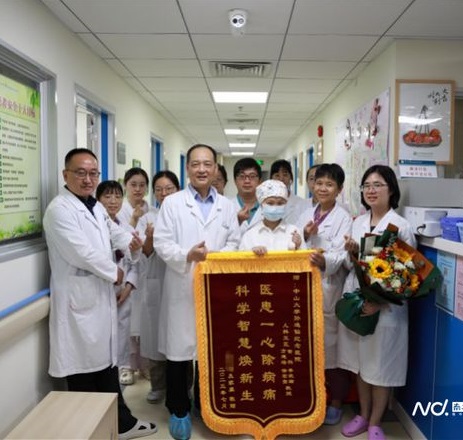
Xiaolin and her family presented a thank-you letter to the medical team.
"Gene scissors" repair defects and can become a new hope for treating beta-thalassemia patients
Professor Fang Jianpei pointed out that gene therapy refers to repairing defective genes through various technologies to achieve the purpose of alleviating or curing diseases. The CRISPR/Cas gene editing system is a tool called "gene scissors".
Severe thalassemia is a genetic disease caused by globin gene mutations leading to insufficient hemoglobin synthesis. The gene therapy received by Xiaolin uses CRISPR/Cas gene editing technology to repair the disease-causing genes in autologous hematopoietic stem cells, reactivating the synthesis of fetal hemoglobin, thereby achieving the purpose of treating beta-thalassemia.

About Reforgene
Reforgene Medicine is one of China's leading innovative gene editing drug companies, driven by gene editing technology and dedicated to bringing novel medicines to life. The company has pipeline programs across genetic diseases and complex diseases. Its innovative beta-thalassemia medicine has achieved globally leading clinical progress, and it achieved the world's first cure of an alpha-thalassemia patient.
Media Contact
info@reforgene.com · BD@reforgene.com